• Skip to primary navigation
  • Skip to content
  • Skip to primary sidebar

Intelligence 101

Teaching You About Intelligence Analysis

Become a Better Intelligence Analyst – Get Started Here!

  • Get Started Here
  • HOMETake me back
  • ABOUTWhat We’re About
  • All-Source IntelligenceSee All Our Blog Posts Here
    • Analytical Tradecraft
    • All Source Intelligence
    • Criminal Intelligence
    • Human Intelligence (HUMINT)
    • Imagery Intelligence (IMINT)
    • Intelligence Agencies
    • Measurement and Signature Intelligence (MASINT)
    • Military Intelligence
    • Open Source Intelligence
    • Psychological Operations (PSYOPS)
    • SIGINT
    • Spying and Espionage
    • Surveillance
  • RESOURCESTools of the Trade
    • Frequently Asked Questions
    • Ebook
    • Open Source Intelligence Masterclass
    • Intelligence Analysts Bookshelf
  • CONTACTGet in contact

What’s Your Level Of Certainty? On Words of Estimative Probability

By Ben Stark on July 13, 2018 2

Let me ask you a question –


Question: “How sure are you?”

Answer:

a) “I’m pretty sure”

b) “There’s a high potential”

c) “I’m not uncertain”

d) None of the above.

In this weeks article, we discuss this article on ‘words of estimative probability’.

Now before your eyes glaze over and you scroll to the funny gifs, here’s why this article matters:

Intelligence professionals deal in uncertainty, so we need a common language and shared understanding.

Eh?

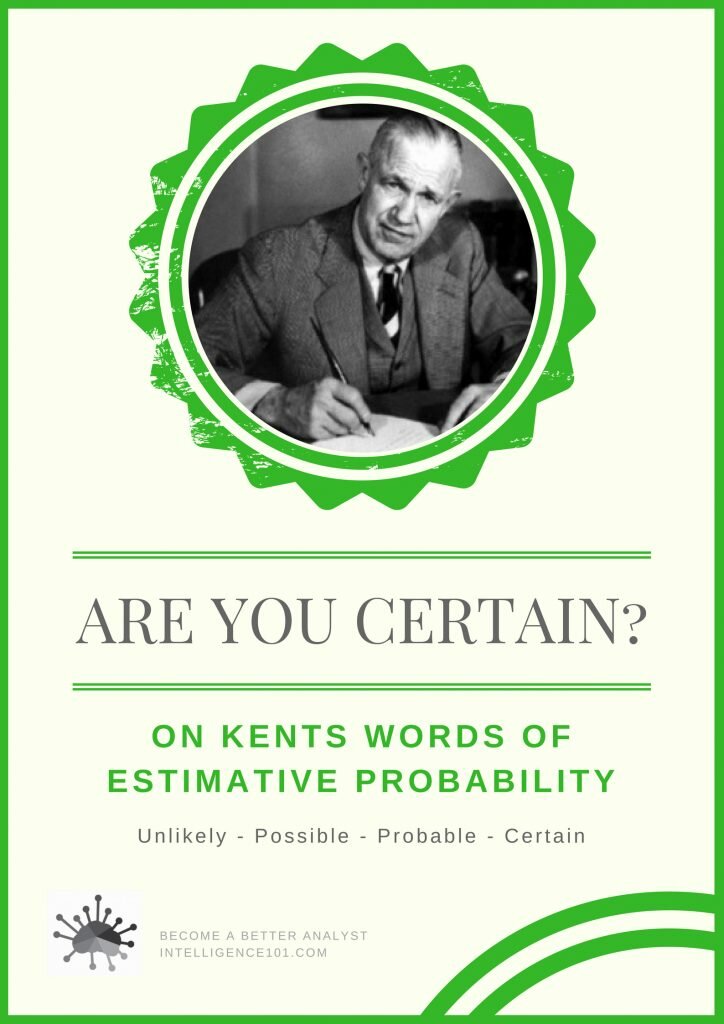
Ok, Let me take you back to the 1960’s when Sherman Kent (<- kind of a big deal) wrote a classified article for the CIA titled “Words of Estimative Probability.”

Problem: In his article, Kent discusses the need for common words to provide estimative meaning in intelligence assessments.

Why?

Intelligence requires us to make predictions, to give estimates and provide assessments.

To do this, we need to be able to qualify what we mean. We need a common language and a shared understanding.

Intelligence is NOT an exact science

Remember: Assessments are predicated on your understanding of the situation, and the quality / volume of information available.

A ‘probability’ is based on a ‘best guess’ –  more quality information allows for a greater degree of certainty when making an assessment.

So what are the odds?

I was taught to use the following words to provide an intelligence assessment – Each of these words used a ‘percentages of probability’

  • Unlikely <15%,
  • Possible >15%,
  • Likely >50%,
  • Probable >75%, and
  • Certain >95%.

Kent Says: 

Considerations

  • Don’t Modify. Importantly, when using the terms above, we don’t add ‘modifiers’, such as; ‘very possible’ or ‘highly likely’, as these can change the meaning and confuse.
  • Not all information is created equal. Just because there might be more reporting doesn’t automatically increase the probability. Quality beats quantity.

Adoption

Everyone needs to speak the same language – what’s the point of me telling you something is ‘certain’ if you interpret it as ‘certainly possible’.

In Summary

Intelligence professionals deal in uncertainty, so we need a common language and shared understanding. Intelligence still needs shared terms to building collective understandings.

I’ve had a few people offer different various terms or percentages – let me know what you think?  Do you use these words? are the percentages consistent with your assessments? Does this method accurately quantify a qualitative assessment?


Check out:
  • The Moscow Rules: 10 Rules Every Spy Should Live By
  • Intelligence Analyst Bookshelf – Essential Reading
  • Information vs Intelligence

Primary Sidebar

Best of Intelligence101

  • Connecting the Dots: How To Use Highlighters To Make Better Sense of Information
  • Fifteen Axioms for Intelligence Analysts
  • How to Become an Intelligence Analyst Today (…even if you’ve got no experience)
  • Intelligence Tradecraft: The Value of Probabilistic Thinking
  • You can now spy on people using your Apple AirPods!

Get Our Newsletter

INTREP: Do You Want To Be A Better Intelligence Analyst? Want Weekly Intelligence Tips and Techniques? Join Our Mailing List Below...

100% privacy. No games, no B.S., no spam. When you sign up, we'll keep you posted with one an email per week.

Categories

  • About Intelligence 101 (1)
  • All Source Intelligence (2)
  • Become A Better Intelligence Analyst (16)
  • Bias (1)
  • Counterintelligence (1)
  • Criminal Intelligence (1)
  • Cyber Intelligence (Hacking) (1)
  • Human Intelligence (HUMINT) (2)
  • Imagery Intelligence (IMINT) (1)
  • Intelligence 101 (10)
  • Intelligence Agencies (3)
  • Intelligence Case Studies (1)
  • Intelligence Resources (2)
  • Measurement and Signature Intelligence (MASINT) (1)
  • Military Intelligence (1)
  • Open Source Intelligence (2)
  • Political Intelligence (1)
  • Psychological Operations (PSYOPS) (2)
  • Resources (2)
    • Product and Service Reviews (2)
  • Security Intelligence (1)
  • SIGINT (1)
  • Spying and Espionage (1)
  • Surveillance (1)
  • Uncategorized (7)

Intelligence Analysts Bookshelf_ Essential Reading For Intelligence Professionals
99 of the BEST Intelligence Resources
Strategic Intelligence & Global Threat Insights: Delivered Everyday by NightWatch
The Ultimate Guide to Human Intelligence (HUMINT)
What University or College Degree Should I Get to Become a Intelligence Analyst?
Tinker, Twitter, Facebook, Spy: Lessons Learnt From The Open Source Intelligence Masterclass
What’s Your Level Of Certainty? On Words of Estimative Probability
PSYOPS: Could this meme be trying to kill you? (Using Memes for Influence Operations)
  • Intelligence 101
  • About
  • Privacy Policy, Terms and Conditions
  • Get Started Here
  • Intelligence Frequently Asked Questions
  • Blog Posts

Copyright © 2019 · Smart Passive Income Pro on Genesis Framework · WordPress · Log in