• Skip to primary navigation
  • Skip to content
  • Skip to primary sidebar

Intelligence 101

Teaching You About Intelligence Analysis

Become a Better Intelligence Analyst – Get Started Here!

  • Get Started Here
  • HOMETake me back
  • ABOUTWhat We’re About
  • All-Source IntelligenceSee All Our Blog Posts Here
    • Analytical Tradecraft
    • All Source Intelligence
    • Criminal Intelligence
    • Human Intelligence (HUMINT)
    • Imagery Intelligence (IMINT)
    • Intelligence Agencies
    • Measurement and Signature Intelligence (MASINT)
    • Military Intelligence
    • Open Source Intelligence
    • Psychological Operations (PSYOPS)
    • SIGINT
    • Spying and Espionage
    • Surveillance
  • RESOURCESTools of the Trade
    • Frequently Asked Questions
    • Ebook
    • Open Source Intelligence Masterclass
    • Intelligence Analysts Bookshelf
  • CONTACTGet in contact

Ben Stark

Strategic Intelligence & Global Threat Insights: Delivered Everyday by NightWatch

By Ben Stark on November 22, 2018 0

Strategic Intelligence & Global Threat Insights: Delivered Everyday by NightWatch

I want to share with you one of the best strategic intelligence subscriptions on the internet.

A few years back when I posted the 99 intelligence resources article, readers commented that I hadn’t included NightWatch.

The truth was, I hadn’t heard of it.

After a little investigation, and subscribing to their digest, I can honestly say NightWatch is one of the best intelligence subscription services available online.

 NightWatch is a must for any serious intelligence analyst.

So, what is NightWatch?

NightWatch is a daily email, sent Monday through Friday covering information about events affecting US national security interests.

The daily digest provides threat analysis and executive commentary of events that pose or advance threats to US national security.

In this weeks’ digest, NightWatch covered significant developments in North Korea, insurgent activities in Kashmir State & terrorist bombings in Afghanistan.

Nightwatch Newsletter Intelligence Subscription Review - Strategic Intelligence


NightWatch covers important events in strategic conflict areas and unique comments about geopolitical developments and strategic intelligence insights.

I particularly like their frank and unapologetic approach to reporting information and analysis.

How does Nightwatch Work?

Nightwatch uses Open Source Intelligence to identify security incidents, threat warnings, and developments.

They highlight the issue and provide great analysis which clearly splits raw facts from their accurate commentary.

The NightWatch team follow a story as it develops and track it through to the end, which speaks of a dedicated team who ‘own their environment’ and finish what they start.

The organization of each edition is the same every day. NightWatch ‘follows the sun’ starting with developments in the Pacific Ocean and Asia then across the middle-east, Africa and at home.

NightWatch is an easy to read digest covering significant developments, conflict and threats in a 24hr period,

NightWatch isn’t afraid to make a call.

From Secret Beginnings…

NightWatch originally began as a highly classified publication to support the Director of Intelligence (J2) in the Pentagon.

In 2006, NightWatch became an experiment in analysis of open source intelligence.

The experiment was to determine whether unclassified data provided enough substance to support the kinds of intelligence judgments provided to senior US government officials in classified channels.

The experiment continues today…with impressive results.

NightWatch Track Record

NightWatch boasts at least 97% accuracy in its judgments since 2006.

In 2017, NightWatch published 250 editions containing 1,432 articles on 28 countries.

Those articles contained 4,801 judgments whose accuracy for the year was 99%.

Impressive.

The Man Behind the Brief

Mr John McCreary is the owner, chief editor and writer of the daily publication.

Mr McCreary was formerly a Director of the National Warning Staff, and senior intelligence officer (SL-4) responsible for current intelligence and warning in the J2.

As a highly decorated intelligence analyst in the US Defense Intelligence Agency, he has continued his work since his retirement from the DIA in 2006.

He continues to provide daily updates, based on open source information.

What makes NightWatch Unique?

The criteria for identification of threats (and commentary) is based on more than 50 years of experience in strategic intelligence analysis.

NightWatch applies unique analytical techniques derived from Dr. James Miller’s seminal work, Living Systems.

Mr McCreary believes using this method, international behaviour is highly predictable.

Who is Nightwatch for?

NightWatch is the best subscription service for people working in the geopolitical, strategic, international and foreign relations spaces.

In particular, NightWatch is an absolute must for Strategic Intelligence Analysts, Geo-political analysts, Flashpoint analysts  (including those with a focus on Korea, Syria, & US tensions).

What’s the cost?

Unlike the other (often overpriced) subscription services, which can cost over $600.00 annually

NightWatch costs only $30.00 PER YEAR, which equates to $0.57c per week!

That’s approx $0.11c per email.

Tip: you can also claim your annual subscription as a tax expense.

Click here to sign up

Is it worth it?  

IMO, NightWatch is a must for any informed intelligence professional.

Personally, I love the no-BS tone of the reporting and the presentation of information.

Best of all, there’s no sensationalised click bait – One email, once a day (Mon-Fri).

Just relevant information and accurate assessment.

The way intelligence should be.

For more information on the NightWatch Subscription, or to sign up – click here. 

Nightwatch Intelligence subscription review

The Ultimate Guide to Human Intelligence (HUMINT)

By Ben Stark on October 12, 2018 0

The Ultimate Guide to Human Intelligence (HUMINT)

Human intelligence (HUMINT) is intelligence collected from people.

HUMINT involves collecting information through a variety of conversational techniques, in a wide variety of circumstances.

HUMINT ‘operators’ are typically referred to as Intelligence Officers who use talent spotting, rapport building, and source recruitment to collect on information requirements.

In this article we dive into the world of HUMINT, and discuss;

  • The role of HUMINT Operators (aka Intelligence Officers),
  • The traits of successful HUMINT officers,
  • The skills and tradecraft used in HUMINT,
  • The training required to become a successful HUMINT collector,
  • Difference between HUMINT and other Intelligence Collection Methods, &
  • HUMINT resources you can use for more information and training.

HUMINT


Roles of HUMINT Operators

The role of a good HUMINT officer is to identify sources and groups who have access to required information (usually secret or classified information) and build relationships to extract or collect this information.

While HUMINT collectors are probably best known for their role in recruiting spies and foreign agents, they routinely collect and report information from friendly forces, civilians, refugees, and local inhabitants too.

HUMINT operators also work in liaison roles with other agencies or foreign militaries, screen various personnel, or serve as an interrogator of captured enemy personnel or suspected criminals.

HUMINT personnel may even infiltrate a group or agency.

All of these functions require different skills, some of which overlap.


 HUMINT Skills and ‘Tradecraft’

The skills needed for successful HUMINT collection require extensive training depending on the situation or application.

A good HUMINT collector must be able to do all of the following (and much more):

  • Profile a target, to include their core motivations, needs, wants, and even their dreams and temper triggers.
  • Recognize someone as a viable target – a skill known as ‘Talent Spotting’
  • Leverage the information they know about a person, to steer them into a specific course of action.
  • Understand and recognize mood shifts and nuances in conversation – a skill known as Emotional Intelligence
  • Understand body language, facial microexpressions, and other tiny, barely perceptible clues to a target’s mindset.
  • Successfully use specific techniques to maneuver the target into the place you need them to mentally, emotionally, or psychologically be.
  • Approach, motivate and maintain networks of sources and contacts.
  • Sometimes “become other people,” taking on personalities or roles outside of who they normally are.

Profiling

In the world of HUMINT ‘profiling’ means being able to understand someone to such a great degree that you can somewhat predict their feelings and actions.

Profiling is required to identify someone’s motivations, so ultimately they can be recruited to provide the required information.

Recruitment can occur over a prolonged period with multiple interactions (to build rapport and trust) or over a period of minutes in an interview or conversation.

Profiling involves having an intimate understanding of the following:

  • A person’s strengths and weaknesses—including the ones they are in denial about or unaware of.
  • Their risk factor to your operation and/or goals.
  • Their credibility and reliability.
  • How they’ll behave or react in a variety of situations.
  • How to best leverage all of this information for a successful interaction, whether it be long-term or short-term.

That level of understanding does not come easily in most cases; it often takes a literal study of the target, along with a varying amount of time.

There are various techniques that help HUMINT professionals recognize various traits and motivations to be leveraged either in the moment or later as part of an approach.

The core of profiling is understanding what motivates a person. For some, it’s validation or acceptance; for others, it may be power or ego.

There are several different possible motivators, and each one can be leveraged to steer the target.

If done properly, the target will not know he has been steered—he will only react, perhaps not even aware of why he is compelled to say or do what he is doing.

HUMINT

Psycholinguistics

Psycholinguistic profiling is a tactic used by the Federal Bureau of Investigation and other federal law enforcement agencies, as well as more espionage-based entities.

A person’s language gives many clues as to not only their guilt or innocence in a given situation but also exposes who they are at their core, what their priorities are, and often how they can be best exploited.

Psycholinguistics

Human Terrain Mapping

The core of HUMINT is human terrain mapping.

Just as topographic maps outline mountains and valleys, offering landmarks and allowing someone to forge a path, Human Terrain Mapping outlines the “path” that a collector should take to—and even through—a human target.

Human Terrain Mapping

Asset Targeting

In HUMINT work, professionals need to be able to find, recruit, and maintain various contacts, information sources, and even subordinates that can perform various tasks (such as moving messages or serving as a cut-out).

Assets are chosen based upon a wide variety of criteria including their personality, their level of access to a specific program or information, and their ability or willingness to be exploited or recruited.

Asset Targeting

There are different types of recruits, and HUMINT targets don’t always have to be high-profile.

For example, a factory worker on an aerospace project can be a highly valuable source of information.

Other potential sources could be the wife or significant other of your actual target.

 Targeting is often a slow, calculated process, not a quick cold call.

In some cases, one may even recruit several degrees away from the main target, slowly working their way closer to the goal; a barista at a coffee shop frequented by people who hold information you want, in the hopes of gleaning information from overheard conversations, or someone who works out at a gym with the person you eventually want to approach.

Consideration – Sometimes assets recruit back, and HUMINT professionals need to be able to recognize those efforts. Defectors, walk-ins, and other individuals who seek to offer information or place themselves in a position to be recruited could be looking to fulfil a role in another, opposing operation.

HUMINT collectors can sometimes be in an incredible amount of danger while attempting to recruit a source or asset.

Training Required

Building Rapport and Interpersonal Communication

One of the biggest weapons in a HUMINT professional’s arsenal is the ability to be disarming, to build that interpersonal rapport.

HUMINT operators must able to carry on conversations with strangers in a friendly, engaging way, build rapport by ‘pushing the right buttons’ .

How? Start engaging people with trivial comments about ‘the weather’, ‘the game on the weekend’ or their shoes (it doesnt matter).

Personally, I like to note the front page of the newspaper each day when I get my coffee. Then I use the headline as a conversation starter…

Keep in mind that rapport doesn’t necessarily mean that the source likes or cares about the HUMINT professional.

In fact, it’s possible to have a level of dislike from the source and yet still have a valuable informational relationship.

Common misconception: Rapport is not ‘getting your source to like you.’

Building rapport is about doing what is necessary to facilitate the transfer of information. In some cases, a source may respond better to an authoritative or even rude persona. It all goes back to the profiling and adaptability.

TIP: one of the best resources on the topic is the book ‘How to win friends and influence people‘ by Dale Carnegie (first published in 1936).

Building Rapport

Elicitation

Elicitation is the act of collecting information that the target is unaware they’re giving.

This is often done in the form of a casual conversation about a seemingly unrelated subject, meant to pull information while the target thinks you’re just chatting with them.

Not every HUMINT collection effort involves a full-on recruitment, in which the person being approached knows they are expected to provide information or perform an action.

While people who have secrets or access to certain types of information are often on guard while in their official capacity or work-related situations, they may not be as vigilant in “off-duty” scenarios.

Casual conversations at these times, especially if they occur over multiple interactions and while steering clear of sensitive or problematic topics, can often net big informational rewards.

Profiling plays a heavy role, and HUMINT collectors become very adept at recognizing human needs that can be exploited at the moment.

Someone who likes to complain, for instance, can be leveraged if someone offers them a chance to be heard…

Think about that dissatisfied colleague at work who just loves to complain if given a supportive ear.

Someone who needs to feel important or has a high-functioning ego may be a bit more loosely-spoken if they are complimented or looked up to.

Certain human traits and needs lend themselves well to exploitation, and a savvy HUMINT collector understands both those traits and how to recognize and leverage them in a variety of ways—often on the fly.

Elicitation

First Contact or Approach

The first contact with a potential recruit or target when looking to recruit or ‘flip’ a source is a critical one.

in the first instance, introducing yourself as a HUMINT professional working for X entity who wants information from them is obviously a bad idea.

Instead, HUMINT collectors often look for an opportunity to meet the target by “chance,” or be introduced by a mutual acquaintance.

In some cases, they seek to become part of the target’s background—such as the barista or fellow gym-goer—in an effort to slide into the target’s world in a natural way and take advantages of opportunities to chat with them.

In an interrogation scenario, however, the dynamic is much different. The target is well aware that the HUMINT professional wants information and may employ a number of strategies in order to prevent that goal from being realized.

In an approach situation, regardless of whether it takes place in an interrogation room, a foreign village, or your local coffee shop, there are three things that they all have in common:

  1. An approach establishes and maintains a level of conversational control over not only the individual event but the overall collection effort as well.
  2. An approach must begin and maintain a level of increasing rapport with the source or target. If the source does not have a level of trust with the collector, they will not give information.
  3. Create a valid profile for the source, in which suspected motives, needs, wants, emotional stability, cultural mores, and other information is confirmed and leveraged successfully.

There are certain situations in which people also tend to be more forthcoming with information. If a target is in a very stressful or frightening position, for instance, the first person they talk to who shows them kindness and compassion is in a great position to glean information.

People also tend to open up when they think they are speaking to someone who shares their worldview.

Therefore, a non-judgmental reaction—no matter what is confessed to or talked about—is critical.

Law enforcement uses this tactic often when talking to suspects in violent or sexually-based offences.

If the suspect feels they will be judged for what they say, they may not say it at all.

A sympathetic posture is often more effective, regardless of one’s own feelings are about the subject matter being discussed.

The Successful HUMINT Professional

Human intelligence is far more than ‘just talking to people.’

In order to do all of these things, the collector must possess the following traits:

  • Patience
  • Alertness
  • Credibility/Integrity
  • Objectivity
  • Self-control/Self-discipline
  • Adaptability and flexibility
  • Perseverance

So how do you become a HUMINT Collector?

While most HUMINT collectors get their start in the military or a federal agency such as the CIA, there are other avenues to a career in HUMINT, including a select few colleges with a HUMINT program.

These programs are generally taught by former or current professionals in the field.

During these programs, would-be HUMINT collectors learn skills like elicitation, profiling, and human terrain mapping—among many, many others.

For more information see our popular post – The ULTIMATE Guide to Becoming An Intelligence Officer…(With Frequently Asked Questions)

HUMINT vs. Other Collection Sources

There are many different intelligence disciplines—and each one brings its own pros and cons to the table. Comparatively speaking, HUMINT offers a literal up close and personal view of the collection process as opposed to SIGINT or IMINT, which can do its work across the globe from its target. It requires no technical knowledge or equipment and can be done on a desolate mountaintop in Afghanistan as well as a crowded venue in New York City.

HUMINT does have a few drawbacks. It’s the most subjective of all the disciplines and arguably requires the most fluid of skills. In addition, there’s more of a margin of error; if the collector misses cues, fails to properly build rapport, or is not adept at deception detection, they could be fed false or misleading information.

Conclusion

HUMINT is not the “best” or “worst” type of intelligence; it’s merely different than many of its more technical counterparts.

Not everyone is cut out to be a HUMINT collector, and the training can be intense. It is, however, an extremely rewarding career if one can learn to do it well—and the skills learned can be used for an incredible amount of good.


What University or College Degree Should I Get to Become a Intelligence Analyst?

By Ben Stark on August 19, 2018 0

What University or College Degree Should I Get to Become a Intelligence Analyst?

I get asked this question a lot actually –

What university or college degree should someone study if they want a job in intelligence or working as an intelligence analyst?

My answer is it doesn’t matter.

Honestly, it doesn’t matter.

Any degree will help you because there are a number of reasons intelligence agencies and organizations set the requirement to have a college degree as the minimum standard.

What University or College Degree Should I Get to Become a Intelligence Analyst

A College Degree is Often Required Because It Shows A Basic Level of Intellect

Firstly a college shows a level of intellect to get into in the first place.

Obtaining a degree shows intelligence agencies that you’ve got the commitment to your studies, an ability to conduct research and critically analyze problems.

So whether you’re a chemistry, maths, criminology or a law student you’re asked to research, analyse and find solutions just to get the grade.

Obviously, the more dedicated you are to your studies the better your grades will be – which is important for intelligence analysts.

A College Degree Shows Intelligence Organisations a Level of Commitment

Secondly, obtaining a college degree shows to intelligence agencies you can stick it out.

College degrees take anywhere from three, four, five, up to six years to complete.

Obviously, a Master’s and a PhD shows the deeper level of intellect as well.

College Degrees shows intelligence agencies you can achieve a minimum standard.  It’s not something you can do for just 12 months.

“Is there a particular type of degree I should get for a job in intelligence?”

If you’re interested in working in the criminal space, or as a criminal intelligence analyst, working on something such as law obviously, criminal justice, criminology, policing, social sciences all help because they support that particular type of work.

However, if you’re interested in a job in intelligence analysis you shouldn’t be restricted by a particular type of degree.

Clearly, if you’re interested in dentistry or podiatry that’s perhaps not consistent with a job in intelligence, so obviously you want a degree that gives you a little bit more focus.

What University or College Degree Should I Get to Become a Intelligence Analyst

However, I know that when intelligence agencies advertise they don’t discriminate between the types of degrees.

But, I do have an opinion on the type of degrees that will be or are preferable…

When I say ‘preferable’ I mean, I think these degrees are better than others. Again, not necessary but preferable.

Ranking them I would say a law degree ranks quite highly because it usually is harder to get into and shows a good level of intellect, but also it requires research and analytical ability.

After that, I would say degrees such as criminology, criminal science, psychology and even teaching are good degrees to get and to have as qualifications.

There are also other degrees good for intelligence analysts such as political science, international affairs, international relations.

What about those intelligence specific degrees or Counter-Terrorism degrees? Should I do this if I want a job in intelligence?

Question: Should you do one of that intelligence analysis or terrorism specific degrees if I want a job in intelligence?

Answer: No.

Personally, I think they’re gimmicky, and a little too niche.

I think you should get a qualification that could provide opportunities in other areas.

International relations, political science or strategic studies are good examples.

Intelligence Analysis

Are Some Universities Better Than Others?

Yes.

Look, gone are the days of CIA recruiters scouring the halls of prestigious colleges for the best students.

In reality, intelligence agencies receive THOUSANDS of applications a month. So they’ve got a bevvy of decent applicants to choose from.

But a degree from a better university is always likely to be viewed higher than a backwater technical college.

But don’t let this dissuade you. Grades also matter – a student with straight A’s at a second-rate university is still going to be viewed more favourably by intelligence organisations than an average student at a better institution. In the end it how you apply yourself.

Entry Requirements Differ

Of course, depending on your state or chosen intelligence agency – the entry requirements will differ.

I recommend you find out what area of intelligence you’re interested in (domestic, international, political, criminal etc), then choosing your intelligence agency/organisation to apply to.


Tinker, Twitter, Facebook, Spy: Lessons Learnt From The Open Source Intelligence Masterclass

By Ben Stark on August 1, 2018

Tinker, Twitter, Facebook, Spy: Lessons Learnt From The Open Source Intelligence Masterclass

When it comes to OSINT…I thought I knew what I was doing!

I’ve been an Intelligence Professional now for practically a decade.

And, I thought I could Facestalk with the best of them.

I mean, I’ve got my alternative log-ins, and I keep pretty regular tabs on friends, family and ex-girlfriends.

“Aint’ nothing getting past me, right?” … Or so I thought.

But I was wrong. So very wrong.

Before, when I searched a Facebook profile – if there wasn’t any information accessible, I simply packed up and went home.

Private FacebookOSINT Open Source Intelligence

OSINT on fleek 

Yep, before I’d clumsily stumble through Google searches, praying for public Facebook profiles and using only the public LinkedIn info.

If you were smart enough to lock down your privacy settings and restrict your friends, photos and college mistakes – you were pretty safe.

But, I wanted to be an online ninja – like the Mossad of the internet.

So I started looking for courses to improve my online research and to gain access to better tools, skills and techniques for Open Source Intelligence.

This is when I found Brians’ Open Source Intelligence Masterclass – designed for Analysts, Private Investigators and Police.

After I consumed all the video content (8+ hours), I strutted back into the office feeling like Nero from the Matrix.

Open Source Intelligence Course

This was the moment my Open Source Intelligence journey really began;

  • I applied the OSINT techniques to Facebook.
  • I looked up friends, family (and yes even an ex or two).
  • I went back over previous work.
  • I even used the checklists and downloads in the office.
  • I was shocked by how much I didn’t know. It’s actually a little embarrassing.

This month, friends and colleagues have been begging me if I can teach them OSINT TTPs.

So, I’ve shared with them the key points and tools from the Open Source Masterclass to take them through the process.

OSINT Ninja Tool 1: Burner is an application that allows you to buy phone credits and make calls with a temporary phone number. This allows you to mask your caller ID and appear to be dialling from local numbers.

Burner App Open Source Intelligence OSINT

OSINT Ninja Tool 2: Spydialer allows you to lookup both cell phones and landlines; social network (based on phone number) and their outbound-voicemail capture allows you to record a target’s voice-mail without their phone ringing. (US Only).

Spy Dialer OSINT Open Source Intelligence Tools

OSINT Ninja Tool 3: Archive.org has 20+ years of web history saved in its databases – That’s like 279 Billion Web pages and growing! This provides the OSINT analyst with an amazing tool if they’re searching for a historical website, or data no longer available on the net – certainly one to add to your set of favourites!

OSINT Tools Way Back Machine Open Source Intelligence

About the OSINT Masterclass Course

The main part of the Open Source Masterclass is an 8-hour program that will take anyone (you, your colleagues, even a police officer) through the basics of OSINT collection, and analysis.

What I liked is that everything was included and it was self-paced. Meaning I could complete the course on my own time.

I loved that Brians’ course provided me with a good foundation and introduced the various information sources and databases to use.

This course taught me the exact Open Source techniques to use no matter what case or target file lands on my desk.

Here’s my Summary

 Learn to think like an Investigator. Getting into the right mindset is the most important step. Don’t do a single thing until you actually understanding what OSINT can be used for, and the tools available at your disposal. Remember, with great power comes great responsibility. Onwards.

 Manage your research time in an orderly and efficient manner. Honest confession. Before this course, I subscribed to the “scattergun approach” of OSINT. Some of you will know this looks like – 15+ tabs open in chrome following every social media rabbit without any real process…phew exhausting.

See the OSINT tools, tips and tactics an actual investigator uses. Teaching and explaining only goes so far, and since I’m a hands-on learner I want to see how these tools work. Brian records his computer screen and so it’s like we’re in the room with him.

Easy to understand practical advice (even for a Mac user). I’m an analyst – not a hacker, so give me info, not code. As soon as something starts to become too technical or involves the words “kernel, bios or Linux” I’m outties.

The Best Part was that Brian’s Open Source Masterclass is non-technical and presents easy to understand and practical ways to;

  • Find addresses and phone people using available resources.
  • Identify former employees of a company or organisation.
  • Draw connections between people, places, and things.

Case Study: Monitoring and analyzing online activity of an Activist Group

This is the future of OSINT. In fact, a previous job required me to track and monitor activist groups online.

I was consulting with a large resource company in the oil & gas sector.

A group on environmental activists were planning protest action, they intended to board an offshore oil rig, chain themselves to the asset and prevent the operation of the facility.

This activity would cost the business millions of dollars in production per day. 

Using our OSINT skills, we were able to monitor the group’s online presence, including their events and identify specific ‘calls to action’ which provided us early warning of their activities.

Ultimately we were able to detect their intentions and act first to avoid loss of production and reputational damage to the company.

At the end of the course, I was able to:

  • Prepare an open source investigation action plan.
  • Conduct a thorough open source intelligence investigation,
  • Know where to start, what resources to use and how to structure your investigation to avoid information overload.
  • And, whether or not my ex did end up marrying that other guy…She did.

Learn Open Source Intelligence from a Top Professional Investigator

Without Open Source Intelligence Masterclass I’d probably still be clicking through to page 3 on Google and convincing myself this was Open Source Intelligence.

I’d probably still be clicking through to page 3 on Google and convincing myself I was ‘doing’ Open Source Intelligence.

Now I’ve Completed the Open Source Masterclass I’ve got a good foundation of knowledge from a professional investigator who knows their stuff and uses these techniques every day.

This Course Has Increased Our Capabilities

My Boss: “Hey, I’ve got someone I need you to take a look into”…

Music to my ears. You know why? Because this meant our team was providing more value! Anyone ego driven intelligence analyst can tell you – it’s good to be needed!

And greater access to information (and better skills), means you’re more valuable to the customer and able to provide a better service.

Mike (Intelligence Officer): “I bet you won’t be able to find anything on me!”

– Challenge accepted Mike.

This week a colleague of mine named Mike challenged our team to find anything we could on him using only open sources.

He believed he had optimised his Facebook privacy settings so much that there was “no possible way” I could find any information about him. He was wrong.

**Sorry Mike. OSINT – 1, Your Facebook Privacy Settings – 0.

p.s. Nice Wedding Photos…

Onwards,

“I showed her some tips and she got a helluva lot better, pretty much instantly”.

I have a lady in my team who came to us outside of the usual recruiting process.

She has a HR background but came to us a ‘redeployee’, meaning due to structural changes her position was re-rolled.

I’ve shown her the OSINT tools, tips and tactics and she’s taken to it like a duck to water.  She’s now our teams dedicated OSINT analyst!

I Should Have Done It Sooner

It’s taken me ten years of Intelligence experience, two overseas deployments, multiple promotions, countless books and hundreds of hours trying to figure out how to collect, analyse and create actionable intelligence.

For less than $XX the Open Source Masterclass will impart the skills you need to learn OSINT in HOURS, rather than years. You even get the tools to use along the way.

In fact, here’s a tool you can download and use RIGHT NOW…

Here’s how to see hidden photos on Facebook – Super Easy

Step 1: Check out and download the Picture Mate extension for Chrome.

Step 2: Once you’ve downloaded the app, the little icon appears in your extension bar (top right)

Step 3. Next, go to someones facebook profile (Choose someone with tight privacy settings).

Step 4: Press the button and watch the magic happen.

Check out this example above. Mikes FB Account has tight privacy Settings (left) but watch what happens when we use the Picture Mate app to reveal hidden photos. Bboom! we can see more than he wanted us to (right).

You’re welcome.

Open Source Intelligence Masterclass – Frequently Asked Questions (FAQ)

Q: How long does this course take?

A: The course contains 8 hours of video content. It’s self-paced, allowing you to complete it when you have time. Learning all the tools and resources depends on how often you use them.

Q: How is it delivered?

A: It’s video content presented by the PI People, you log in and complete the course in their student portal.

Q: Can’t I just learn this somewhere else?

A: Maybe. I mean, there’re heaps of good resources out there, I actually recommend checking some others on the blog also. But Brian is a professional Investigator who does this every day for a living. He knows his stuff, and it’s all in one place.

…AND INTRODUCING THE COURSE INSTRUCTOR


Brian Willingham, of Diligentia Group, has spent 15 years conducting public record and open source research.

He’s worked high-profile cases with some of the top investigative firms in the world.

In his OSINT masterclass, Brian distils 15 years of investigative experience into a full workday of intensive videos, providing checklists and specific “go to” sites.

Brian blogs over at Diligentiagroup (his investigative firm) and has contributed to a number of industry magazines and publications like Pursuit Magazine, PINow.com and ACFE Insights for the Association of Certified Fraud Examiners.

I Got 99 Problems But OSINT Aint’ One.


What’s Your Level Of Certainty? On Words of Estimative Probability

By Ben Stark on July 13, 2018 2

What’s Your Level Of Certainty? On Words of Estimative Probability

Let me ask you a question –


Question: “How sure are you?”

Answer:

a) “I’m pretty sure”

b) “There’s a high potential”

c) “I’m not uncertain”

d) None of the above.

In this weeks article, we discuss this article on ‘words of estimative probability’.

Now before your eyes glaze over and you scroll to the funny gifs, here’s why this article matters:

Intelligence professionals deal in uncertainty, so we need a common language and shared understanding.

Eh?

Ok, Let me take you back to the 1960’s when Sherman Kent (<- kind of a big deal) wrote a classified article for the CIA titled “Words of Estimative Probability.”

Problem: In his article, Kent discusses the need for common words to provide estimative meaning in intelligence assessments.

Why?

Intelligence requires us to make predictions, to give estimates and provide assessments.

To do this, we need to be able to qualify what we mean. We need a common language and a shared understanding.

Intelligence is NOT an exact science

Remember: Assessments are predicated on your understanding of the situation, and the quality / volume of information available.

A ‘probability’ is based on a ‘best guess’ –  more quality information allows for a greater degree of certainty when making an assessment.

So what are the odds?

I was taught to use the following words to provide an intelligence assessment – Each of these words used a ‘percentages of probability’

  • Unlikely <15%,
  • Possible >15%,
  • Likely >50%,
  • Probable >75%, and
  • Certain >95%.

Kent Says: 

Considerations

  • Don’t Modify. Importantly, when using the terms above, we don’t add ‘modifiers’, such as; ‘very possible’ or ‘highly likely’, as these can change the meaning and confuse.
  • Not all information is created equal. Just because there might be more reporting doesn’t automatically increase the probability. Quality beats quantity.

Adoption

Everyone needs to speak the same language – what’s the point of me telling you something is ‘certain’ if you interpret it as ‘certainly possible’.

In Summary

Intelligence professionals deal in uncertainty, so we need a common language and shared understanding. Intelligence still needs shared terms to building collective understandings.

I’ve had a few people offer different various terms or percentages – let me know what you think?  Do you use these words? are the percentages consistent with your assessments? Does this method accurately quantify a qualitative assessment?


Check out:

  • The Moscow Rules: 10 Rules Every Spy Should Live By
  • Intelligence Analyst Bookshelf – Essential Reading
  • Information vs Intelligence

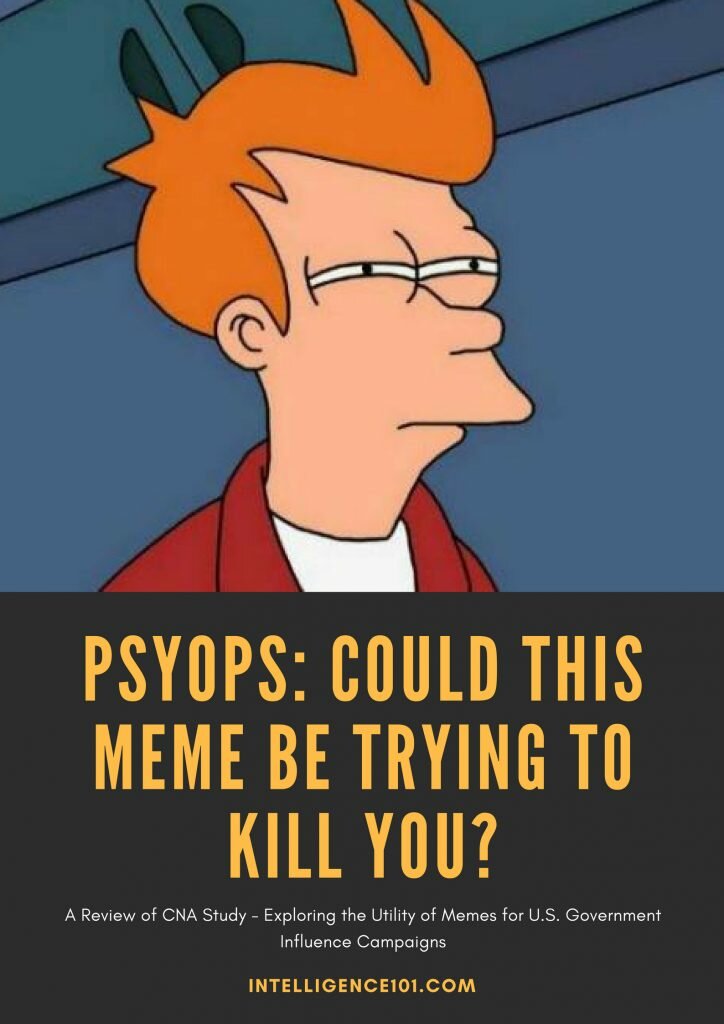
PSYOPS: Could this meme be trying to kill you? (Using Memes for Influence Operations)

By Ben Stark on July 5, 2018 0

PSYOPS: Could this meme be trying to kill you? (Using Memes for Influence Operations)

Well fuck me…

I just finished reading a study on ‘the Utility of Memes for U.S. Government Influence Campaigns’, released by the CNA, a nonprofit research and analysis organization.

This was probably one of the most interesting article I’ve read in months.

You would have to be living under a rock to be unaware of news about Russian information operations, and recent PSYOPS initiatives à la Cambridge Analytica; but, 

Could sharing funny memes actually be used as a form of information warfare?

The CNA suggests they could!

Read the full CNA article at this link here, or you can download a PDF version here.

I’ve summarised the articles key points here:

How Could Memes Be Used In Information Operations?

People like pictures. Images offer some advantages over text, making visual memes well-suited for influence campaigns.

  • Images are liked and shared three times more frequently than other types of online content;
  • Images increase the likelihood someone will follow instructions (people perform over 300% better with accompanying images);
  • Images significantly improve information retention.

Inoculate, infect, and treat.

CNA identified three ways memes may be situated intentionally within information and influence campaigns:

  • to inoculate,
  • to infect, and
  • to treat.

CNA identified three ways memes may be situated intentionally within information and influence campaigns:

Inoculate: To use a meme in an effort to protect against a threat or anticipated attack.

  • Example – the CNA report used a case study from Japan showing how ‘Japan is fighting ISIS with Super-Kawaii Tweets’. While the Japanese campaign provoked controversy, it was effective in undermining ISIS’s image.

Infect: To use a meme to spread a specific message—that aligns with broader mission objectives.

  • Example – Russian interference in U.S. presidential election.

  • Example – ISIS sympathizers launched Twitter Account to portray a ‘softer’ side to ISIS

Treat. To use a meme to treat an already circulating message.

  • Example – In 2015, the U.S. Embassy in Russia responded to a Russian disinformation campaign by promoting fake news about U.S. Ambassador John Tefft.

  • The U.S. embassy effectively treated the Russian attempt to infect—by turning Tefft’s image into a meme and created their own photoshopped images to mock the fake story.
Meme Translation: “Ambassador Tefft spent yesterday’s weekend at home. But thanks to Photoshop you can be anywhere.” #fake #fake

Advantages:

  • Utility. Memes have utility in information and influence campaigns to counter state actors such as Russia and non-state actors such as the Islamic State.
  • Shared Language. Memes constitute a “shared cultural language.”
  • Emotionally evocative. Research shows emotional cues are preferentially processed in the brain. –Which might explain why we scan internet articles and stop at the pictures.

Issues / Disadvantages:

  • Change behaviour. Changing attitude does not necessarily change behaviour.
  • Hard to measure. It’s hard to measure the effectiveness and success of memes for off-screen behaviour.
  • Meh Factor. They need to be relevant to the audience – and ‘stick’

Conclusion. Memes have significant potential for enhancing influence campaigns but additional research is needed to understand how to employ them effectively.

Resources:

  • Here’s the link to the full article, or you can download a PDF version here.
  • Link to the CNA homepage (they wrote the study)
  • AnalystAF – Intelligence Analyst Memes – for LOLs
  • PSYOPS – Related Article

Question:

Have you got experience working in PSYOPS? Are you part of the information operation community? If so, tell us – Do you think Memes have potential in Information Warfare? And more specifically, how could they be measured (i.e. shares, comments)?

Let us know.

  • « Previous Page
  • Page 1
  • Page 2
  • Page 3
  • Page 4
  • …
  • Page 10
  • Next Page »

Primary Sidebar

Best of Intelligence101

  • Connecting the Dots: How To Use Highlighters To Make Better Sense of Information
  • Fifteen Axioms for Intelligence Analysts
  • How to Become an Intelligence Analyst Today (…even if you’ve got no experience)
  • Intelligence Tradecraft: The Value of Probabilistic Thinking
  • You can now spy on people using your Apple AirPods!

Get Our Newsletter

INTREP: Do You Want To Be A Better Intelligence Analyst? Want Weekly Intelligence Tips and Techniques? Join Our Mailing List Below...

100% privacy. No games, no B.S., no spam. When you sign up, we'll keep you posted with one an email per week.

Categories

  • About Intelligence 101 (1)
  • All Source Intelligence (2)
  • Become A Better Intelligence Analyst (16)
  • Bias (1)
  • Counterintelligence (1)
  • Criminal Intelligence (1)
  • Cyber Intelligence (Hacking) (1)
  • Human Intelligence (HUMINT) (2)
  • Imagery Intelligence (IMINT) (1)
  • Intelligence 101 (10)
  • Intelligence Agencies (3)
  • Intelligence Case Studies (1)
  • Intelligence Resources (2)
  • Measurement and Signature Intelligence (MASINT) (1)
  • Military Intelligence (1)
  • Open Source Intelligence (2)
  • Political Intelligence (1)
  • Psychological Operations (PSYOPS) (2)
  • Resources (2)
    • Product and Service Reviews (2)
  • Security Intelligence (1)
  • SIGINT (1)
  • Spying and Espionage (1)
  • Surveillance (1)
  • Uncategorized (7)

Intelligence Analysts Bookshelf_ Essential Reading For Intelligence Professionals
99 of the BEST Intelligence Resources
The Moscow Rules: Unpacking the 10 Rules Every Spy Should Live By
The Ultimate Guide to Human Intelligence (HUMINT)
What University or College Degree Should I Get to Become a Intelligence Analyst?
Tinker, Twitter, Facebook, Spy: Lessons Learnt From The Open Source Intelligence Masterclass
What’s Your Level Of Certainty? On Words of Estimative Probability
PSYOPS: Could this meme be trying to kill you? (Using Memes for Influence Operations)
  • Intelligence 101
  • About
  • Privacy Policy, Terms and Conditions
  • Get Started Here
  • Intelligence Frequently Asked Questions
  • Blog Posts

Copyright © 2019 · Smart Passive Income Pro on Genesis Framework · WordPress · Log in